
Fertilization
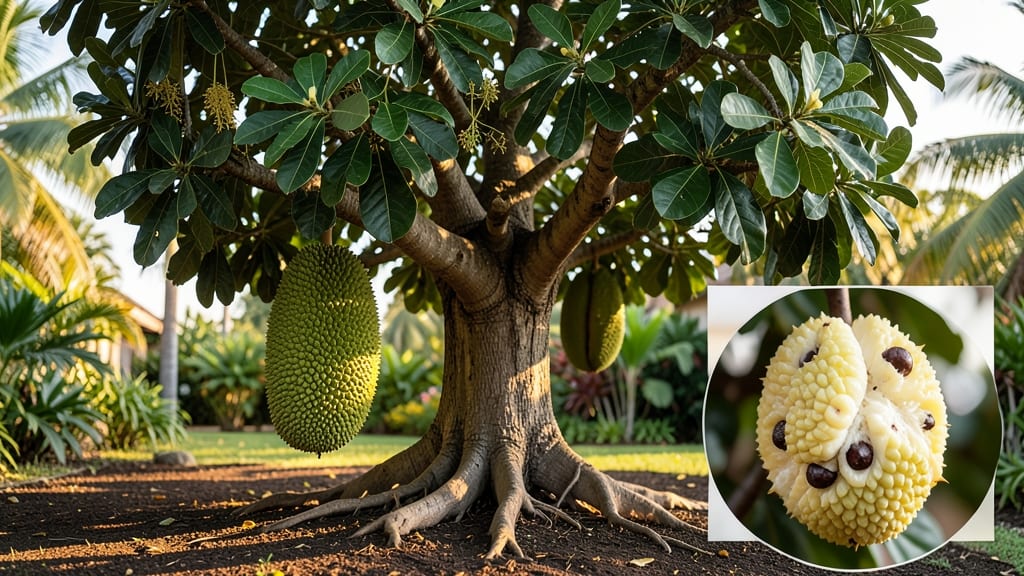
The biggest fruit in the world is the jackfruit, with individual specimens weighing over 80 pounds and some varieties exceeding 100 pounds. Grown in tropical climates, this massive fruit belongs to the mulberry family and rivals the size of small humans.
The jackfruit isn't just the world's largest fruit by weight—it's also one of the most complex, with a single fruit containing up to 500 seeds and a spiky green exterior that can grow up to 3 feet long. 🌿 What's fascinating is how its size varies by region; Southeast Asian varieties like the 'Jumbo' type often surpass 150 pounds, while Indian cultivars typically stay between 50-80 pounds.
This dramatic variation occurs because jackfruit trees thrive in specific microclimates where humidity, rainfall, and soil nutrients create ideal growing conditions.
Beyond its impressive size, jackfruit's versatility makes it a global favorite. While it's often used in savory dishes like pulled pork substitutes in vegan cuisine, its sweet, custard-like flesh when ripe is perfect for desserts.
The tree itself can live for decades, producing fruit year-round in tropical zones, which explains why it's considered a "superfruit" in many cultures.
💡 In This Article
- Jackfruit Size Records and Growth Factors
- Cultivating Giant Jackfruit Varieties at Home
Jackfruit size records and growth factors
The jackfruit's record-breaking size stems from its unique botanical structure and genetic adaptations. Unlike most fruits that grow to a fixed size, jackfruit trees produce fruit through a process called synchronous development, where multiple flower clusters merge into a single massive fruit.
This occurs because the tree's flowers are arranged in dense, overlapping groups called sycopiums, which can fuse into a single fruit weighing up to 100 pounds or more. 🌟 The largest verified specimen, grown in India in 2011, tipped the scales at 110 pounds—equivalent to a small child!
Tropical climates are non-negotiable for giant jackfruit growth. The trees require year-round temperatures between 70-90°F, high humidity (above 60%), and 60-100 inches of annual rainfall to support their massive canopies and fruit loads.
Soil fertility plays a critical role too—jackfruit trees thrive in well-draining, slightly acidic soil (pH 5.5-6.5) rich in organic matter. Without these conditions, the fruit's growth slows dramatically, often resulting in specimens weighing only 20-30 pounds.
Comparing jackfruit to other giant fruits reveals its unique advantages. While durian (another tropical giant) can reach 15 pounds per fruit, its spiky exterior and strong odor limit its size potential. Papaya, though edible, maxes out at 10 pounds and lacks jackfruit's complex internal structure.
The key difference? Jackfruit's artocarpin compounds promote rapid cell division in its flesh, allowing it to expand exponentially during the 6-8 month growth cycle. 🌱 This biological mechanism is why jackfruit consistently outclasses its tropical competitors.
Cultivation techniques further influence size. Pruning young trees to encourage a single strong trunk (rather than multiple weak stems) directs energy toward fruit production. Farmers in Thailand and Malaysia often use organic compost enriched with banana peels and fish emulsion to boost nutrient uptake.
Even small variations in care—like proper staking during storms—can mean the difference between a 50-pound fruit and a 100-pound giant. The result? Some commercial orchards now produce 90% of their trees yielding over 70 pounds annually.
What most people don't realize is that jackfruit's size isn't just about weight—it's about internal complexity. A single fruit can contain 300-500 seeds arranged in a honeycomb pattern, with each seed encased in edible, custard-like arils.
This intricate structure requires massive vascular systems in the tree, which is why only the most robust specimens can achieve record sizes. The world's largest jackfruit varieties often come from cloned trees with genetically enhanced growth traits, proving that nature and nurture both play crucial roles. 💫
For those curious about other giant fruits, consider the mangosteen (though tiny at 1-2 pounds) or the soursop (up to 10 pounds), but neither matches jackfruit's combination of sheer size, edible complexity, and adaptability.
The jackfruit's dominance in the fruit world isn't just about being big—it's about how it grows, thrives, and adapts to maximize every ounce of its potential.