
Blooming
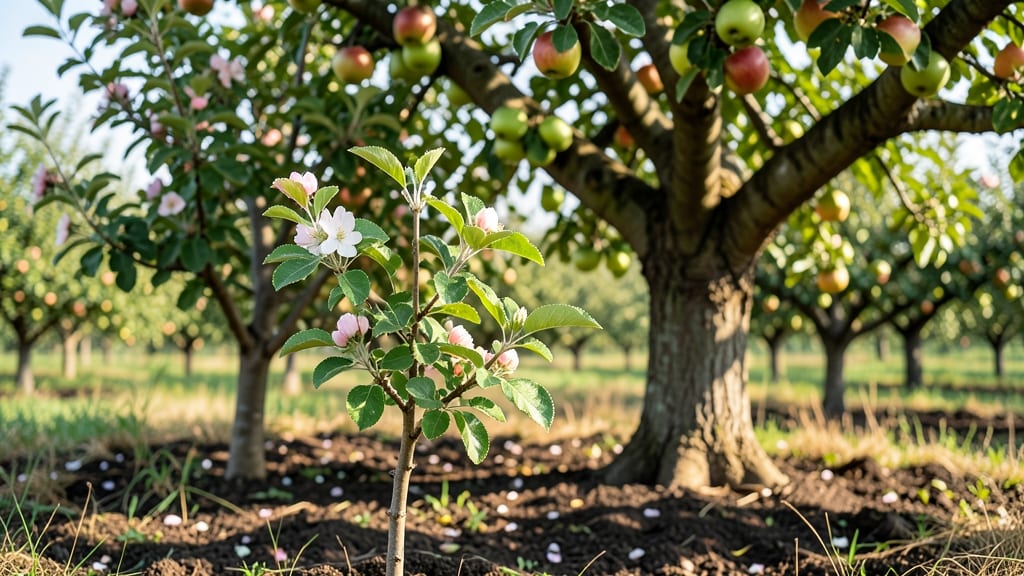
Apple trees take 4 to 7 years to produce fruit on average, with dwarf varieties fruiting in as little as 2-4 years, while standard trees may need 5-10 years. Variety, care, and climate all impact this timeline significantly.
Patience is key when growing apple trees, as their fruiting timeline depends heavily on the specific variety and growing conditions. 🌳 Dwarf trees, for example, are bred to mature faster due to their compact size, making them ideal for backyard orchards.
Meanwhile, standard trees require more time because they grow larger and need to establish a stronger root system. Factors like soil quality, sunlight exposure, and proper pruning can also accelerate fruit production by ensuring the tree stays healthy and focused on bearing fruit rather than just growing leaves.
Another critical factor is pollination. Many apple varieties need a second tree nearby to cross-pollinate, which can delay fruiting if you're growing a single tree. Additionally, colder climates may slow down growth initially, but they're often necessary for certain apple varieties to thrive.
By understanding these variables, you can set realistic expectations and take steps to encourage faster fruiting.
💡 In This Article
- Apple Tree Varieties and Their Fruit Production Timelines
- Optimizing Apple Tree Growth for Faster Fruit Production
Apple tree varieties and their fruit production timelines
The fruiting timeline for apple trees varies dramatically based on their size classification and genetic makeup. Dwarf varieties, like 'Liberty' or 'Enterprise,' are bred to mature in just 2-4 years because their compact root systems require less energy to establish.
These trees typically reach 6-8 feet tall and produce fruit on spurs—short, stubby branches that form near the trunk. In contrast, standard trees like 'Granny Smith' or 'Fuji' take 5-10 years to bear fruit because they need to develop a larger canopy and stronger structural framework. 🌱
Cold requirements also play a crucial role. Many apple varieties need 200-1,000 chill hours (temperatures between 32-45°F) annually to trigger flowering and fruiting. For example, 'Honeycrisp' requires 600-800 chill hours, making it ideal for colder climates, while 'Gala' thrives with just 300-500 chill hours.
Grafting further influences timing—when a desirable fruit variety is grafted onto a dwarf rootstock, the fruiting timeline aligns with the scion (top) variety's genetics, not the rootstock's natural growth rate.
Semi-dwarf varieties strike a balance, typically fruiting in 3-6 years while reaching 10-16 feet tall. These trees are popular for home orchards because they combine faster fruiting with manageable size.
The key difference between varieties lies in their growth habit: dwarf trees focus energy on fruit production early, while standard trees prioritize vertical growth before flowering.
This biological trade-off explains why a 2-year-old dwarf tree might produce 10-20 pounds of apples, whereas a 5-year-old standard tree may yield only 5-10 pounds in its first harvest.
Seasonal growth patterns also affect fruiting. Apple trees form flower buds in late summer, which require consistent care throughout the year. For instance, a tree that receives 1-2 inches of water weekly during dry spells will develop stronger buds than one struggling with drought.
Pruning in late winter removes dead wood and encourages new growth where fruit-bearing spurs can form. Without proper pruning, a tree may produce leaves instead of flowers, delaying fruiting by 1-2 years. 🍎
Consider these common varieties and their typical fruiting windows:
- Dwarf varieties: 'Red Delicious' (3-5 years), 'Golden Delicious' (2-4 years)
- Semi-dwarf varieties: 'Jonathan' (4-6 years), 'McIntosh' (3-5 years)
- Standard varieties: 'Braeburn' (6-8 years), 'Pink Lady' (5-7 years)
Understanding these timelines helps set realistic expectations. A backyard gardener planting a dwarf 'Honeycrisp' can expect their first harvest in 3 years, while someone planting a standard 'Granny Smith' should prepare for a 7-year wait.
The choice between varieties often comes down to available space and patience—dwarf trees offer quicker rewards with minimal space, while standard trees provide larger yields over time.