
Blooming
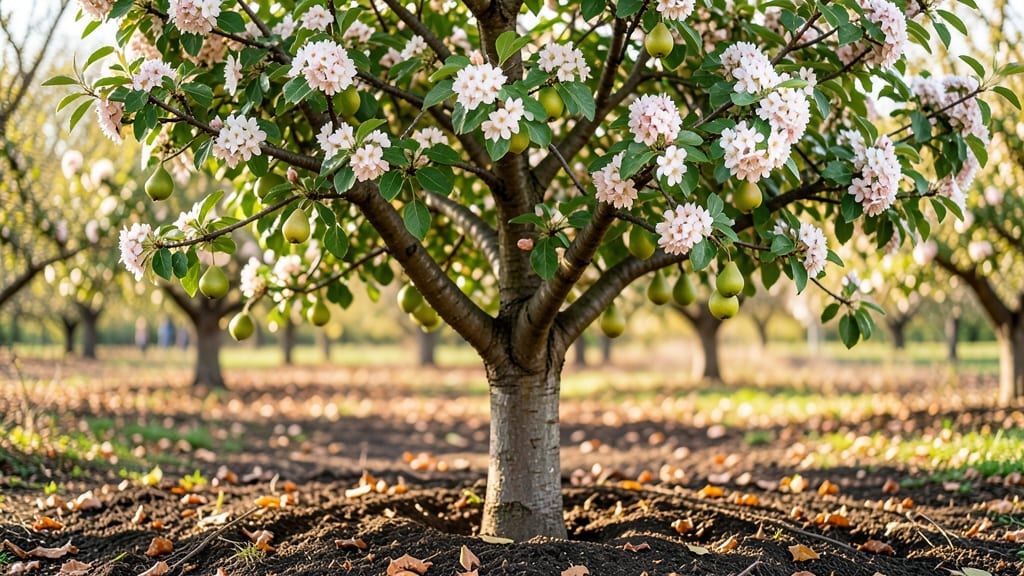
Pear trees take 3 to 7 years to produce fruit after planting, with timing influenced by variety, rootstock, and climate conditions like required chill hours for dormancy and flowering.
Understanding why this timeline varies helps you choose the right tree for your climate. 🌱 Most pear trees need 300–1,000 hours of temperatures between 32–45°F to trigger flowering—areas with milder winters may struggle with standard varieties.
Dwarf rootstocks like 'Old Home x Farmingdale' can cut fruiting time to 2–3 years in ideal conditions, while standard trees may take longer. The key is selecting a variety that matches your region's chill hours for faster results.
For impatient gardeners, early-bearing varieties like 'Moonglow' or 'Seckel' are game-changers. These produce fruit in 3–5 years when planted in suitable climates, and their compact growth makes them perfect for small yards. Proper pruning—removing competing branches and thinning fruit—also speeds up maturity by redirecting energy to fruit production. 💫
💡 In This Article
- Chill Hours Requirements for Pear Tree Fruit Production
- Fastest-Fruiting Pear Varieties for Home Gardens
Chill hours requirements for pear tree fruit production
Pear trees rely on a biological process called dormancy, triggered by chill hours—periods when temperatures drop between 32–45°F for extended durations. These cold exposures reset the tree's internal clock, allowing it to transition from winter rest to spring flowering.
Without sufficient chill hours, buds remain dormant, and no fruit forms. Most pear varieties need 300–1,000 hours of these cold conditions annually, depending on the species. For example, 'Bartlett' pears typically require 500–700 hours, while low-chill varieties like 'Moonglow' manage with just 200–300 hours. 🌡️
The science behind this involves plant hormones called abscisic acid and gibberellins, which regulate dormancy and growth. During cold exposure, abscisic acid levels rise, protecting cells from frost damage while preparing the tree for flowering. Once temperatures warm, gibberellins kick in, stimulating bud break and flower formation.
Regions with mild winters—like parts of California or Florida—often struggle with standard pear varieties because they lack enough chill hours. This is why selecting a variety matched to your climate is critical for faster fruiting.
To check if a pear tree suits your area, consult your USDA Hardiness Zone and local chill hour data. For instance, Zone 5 (like Minnesota) averages 1,200–1,500 chill hours, ideal for most pears, while Zone 8 (like Texas) may only offer 200–400 hours, limiting options to low-chill varieties.
Websites like the National Arboretum's Chill Hour Calculator can help match trees to your location. Planting in microclimates—like near a north-facing wall—can also add 50–100 extra chill hours annually, speeding up dormancy and flowering.
What most gardeners don’t realize is that rootstock choice also affects chill hour sensitivity. Semi-dwarf rootstocks like 'Old Home x Farmingdale' often require 10–20% fewer chill hours than standard trees, making them better suited for marginal climates.
For example, a 'Seckel' pear on this rootstock might fruit in 4–5 years in Zone 6, whereas on a standard rootstock, it could take 6–7 years. This is why nurseries often pair early-bearing varieties with compatible rootstocks to ensure faster results. 🌱
If you live in a warm climate, consider artificial chilling techniques like wrapping young trees in frost blankets during winter or planting them in elevated beds to enhance cold exposure.
Some growers also use hydrogen cyanamide sprays (a dormancy-breaking chemical) to trick trees into flowering earlier, though this is less common for home gardens. The goal is to mimic natural chill hours, ensuring the tree’s internal clock aligns with seasonal cues for optimal fruit production.