
Plants
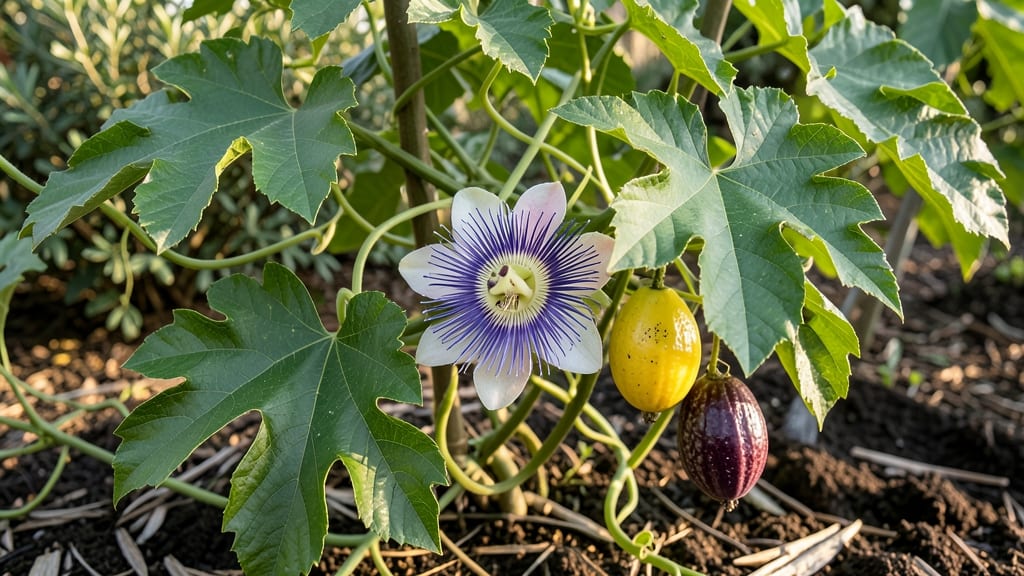
Passion fruit looks like an oval-shaped, wrinkled fruit with a tough, leathery skin ranging from deep purple to golden-yellow, depending on ripeness. Its surface features a crown of spiraled tendrils and a hard, woody core inside when cut open, revealing jelly-like pulp with edible black seeds.
When you first spot a passion fruit, its unique crown of spiraled tendrils is the dead giveaway—no other common fruit has that distinctive, almost alien-like texture. 🌿 The skin's leathery feel and deep wrinkles make it instantly recognizable, whether you're holding a purple passion fruit (the more common variety) or a yellow passion fruit (which tends to be sweeter).
What's fascinating is how the color shifts from green to its mature hue as it ripens, signaling it's ready to be enjoyed—either fresh or blended into smoothies.
The hard core inside might surprise first-time handlers, but that's where the real treasure lies: the vibrant, tangy pulp packed with tiny, crunchy seeds.
This tropical fruit's appearance is so distinctive that I've seen people mistake it for a small pumpkin or even a lychee at first glance. The key differences lie in the crown's spiral pattern and the fruit's overall shape—passion fruit is never perfectly round, always slightly elongated.
If you're shopping, give it a gentle squeeze: a ripe one should yield slightly to pressure, and the color should be fully vibrant, not dull or green-tinged. The weight also matters—a heavy fruit for its size usually means it's juicier inside.
💡 In This Article
- Distinctive Physical Traits of Passion Fruit
- How to Identify Passion Fruit in Grocery Stores or Gardens
Distinctive physical traits of passion fruit
The passion fruit's most striking feature is its crown of spiraled tendrils, which resemble a miniature, intricate flower.
These tendrils aren't just decorative—they're the remnants of the fruit's original flower structure, a botanical quirk that sets it apart from nearly every other fruit. 🌿 The tendrils grow in a tight, clockwise spiral pattern, typically numbering between 5 and 7, and can measure up to 1 inch in length.
This crown isn't just visually unique; it's also a functional clue about ripeness, as it often softens slightly when the fruit is fully mature.
The fruit's wrinkled skin is another defining trait, giving it a textured appearance that feels almost like crumpled paper when touched. This isn't just surface-level—those wrinkles develop as the fruit matures, creating a network of shallow grooves that can be as deep as 1/8 inch in some varieties.
The skin's thickness varies too: purple passion fruit tends to have a slightly thicker, more leathery exterior compared to the thinner, smoother skin of yellow varieties. Interestingly, the wrinkles become more pronounced as the fruit ages, making older specimens look almost gnarled.
Color is where passion fruit gets its most dramatic transformations. Unripe fruits start as a bright green, almost neon hue that gradually shifts through shades of yellow, orange, or deep purple as they mature.
This isn't just a surface change—the color shift indicates chemical transformations inside, particularly in the anthocyanin pigments (in purple varieties) and carotenoids (in yellow varieties).
The ripest fruits will have a uniform color with no green patches, and their skin often develops a slight sheen that's a dead giveaway for freshness.
Inside, the woody core is what surprises most people—it's not just a single seed but a complex, honeycombed structure that can account for up to 30% of the fruit's volume. This core isn't just structural; it's what helps distribute the fruit's juices and seeds throughout the pulp.
The pulp itself is where the magic happens: a gelatinous, jelly-like substance that clings to the core and seeds, with a texture somewhere between a thick puree and a light mousse.
The seeds, often mistaken for inedible, are actually packed with nutrients and add a subtle crunch that many people love.
Size variations are another fascinating aspect. Purple passion fruit typically measures between 2 to 3 inches in length and 1.5 to 2 inches in diameter, while yellow varieties tend to be slightly larger, sometimes reaching 3.5 inches long.
Weight-wise, a ripe passion fruit usually falls between 3 to 5 ounces, with yellow varieties often being heavier due to their higher water content.
The shape is almost always oval or egg-like, never perfectly round, which helps distinguish it from fruits like lychee or custard apple that might be mistaken for it at first glance.
What's often overlooked is how the aroma changes with ripeness. A truly ripe passion fruit will have a sweet, tropical scent that's almost floral, with hints of citrus and tropical fruit.
This aroma comes from volatile compounds like linalool and alpha-terpineol, which develop fully only when the fruit is at peak ripeness. If you're near a passion fruit tree, you'll often catch this scent before you even see the fruit—a natural cue that the harvest is ready.