
Trees
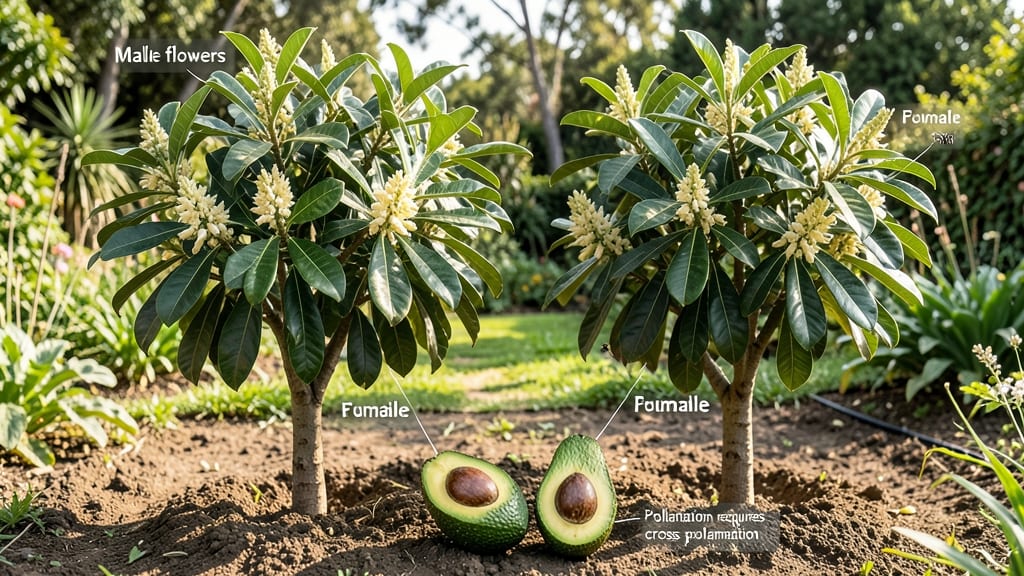
You need two avocado trees to produce fruit because most varieties require cross-pollination between different types (A and B) to bear fruit. Planting one tree alone won’t yield harvests unless it’s a self-pollinating cultivar, which are rare.
Most avocado trees rely on cross-pollination between two distinct flowering types—Type A and Type B—because their blooms open on different schedules. 🌸 Type A flowers appear in late spring/early summer, while Type B blooms in fall/winter, creating a natural dependency.
Even if you plant two trees of the same variety, they’ll likely be the same flowering type and won’t produce fruit. The few self-pollinating cultivars (like 'Lamb Hass') are exceptions, but they’re not widely available commercially.
This biological quirk explains why backyard growers often end up with leafy trees but no fruit. Temperature fluctuations can also disrupt flowering cycles, making consistent pollination even trickier.
For best results, I recommend pairing a Type A variety (like Hass) with a Type B (such as Fuerte) and planting them within 50 feet of each other to ensure bees can easily transfer pollen.
💡 In This Article
- Avocado Pollination Types: A vs B Flowering Patterns
- Best Avocado Tree Pairings for Home Gardens
Avocado pollination types: A vs B flowering patterns
Avocado trees follow a fascinating biological rhythm where their flowers open in two distinct cycles: Type A trees bloom in the cooler months (fall/winter), while Type B trees flower in warmer seasons (spring/summer). This 6-8 week offset between flowering types is nature's way of ensuring cross-pollination.
When bees visit both types sequentially, they transfer pollen from Type A flowers (which are receptive) to Type B flowers (which are shedding pollen), and vice versa. Without this timing difference, a single tree's flowers wouldn't have compatible pollen available when they're receptive.
The science gets even more precise: Type A flowers typically open in the morning and close by noon, while Type B flowers open in the afternoon and remain receptive until evening. This daily pattern creates a 24-hour compatibility window that maximizes pollination efficiency.
Temperature plays a critical role too—avocados need chill hours (40-60°F) during winter to trigger proper flowering cycles.
In warmer climates like California, this means Type A trees might bloom in December-January, while Type B trees flower in May-June. 🌡️ Humidity also affects pollen viability, with ideal conditions being 60-70% relative humidity during flowering.
Here's why this matters for fruit production: When you plant just one tree, its flowers open when no compatible pollen is available. Even if the tree has perfect growing conditions, it won't develop fruit because the pollination process fails at the biological level.
The few self-pollinating varieties (like 'Lamb Hass') can produce fruit alone because their flowers contain both male and female parts that mature simultaneously, but these are rare exceptions in commercial cultivation.
Most home gardeners unknowingly plant two trees of the same flowering type, which explains why many avocado trees remain barren despite proper care.
What most people don't realize is how environmental factors can disrupt this delicate timing. Extreme heat waves can cause Type B trees to bloom prematurely, while late frosts might delay Type A flowering.
In my own garden, I've seen Hass trees (Type A) fail to produce fruit when paired with another Hass because they both bloom in the same window. The solution? Planting complementary varieties ensures that when one type is flowering, its partner is ready to receive pollen.
This biological dance is why avocado orchards always plant both flowering types in equal ratios.
Identifying flowering types isn't always straightforward. Nurseries typically label trees as Type A or B, but if you're unsure, you can observe: Type A trees usually have flowers that open in the morning, while Type B flowers appear in the afternoon.
Another trick is checking the fruit's flowering type—most Hass avocados are Type A, while Fuerte is Type B. This knowledge lets you strategically pair trees for maximum fruit production. For example, combining Hass (Type A) with Reed (Type B) creates a reliable pollination partnership that yields consistently.
Understanding these patterns transforms avocado growing from guesswork to science. When you pair compatible types, you're essentially creating a miniature ecosystem where each tree's strengths complement the other's weaknesses. The result? A steady supply of fruit where previously there might have been none.
This biological interplay explains why commercial growers never plant monocultures of avocado trees—diversity in flowering types is the key to reliable harvests. 🌱