
Succulent
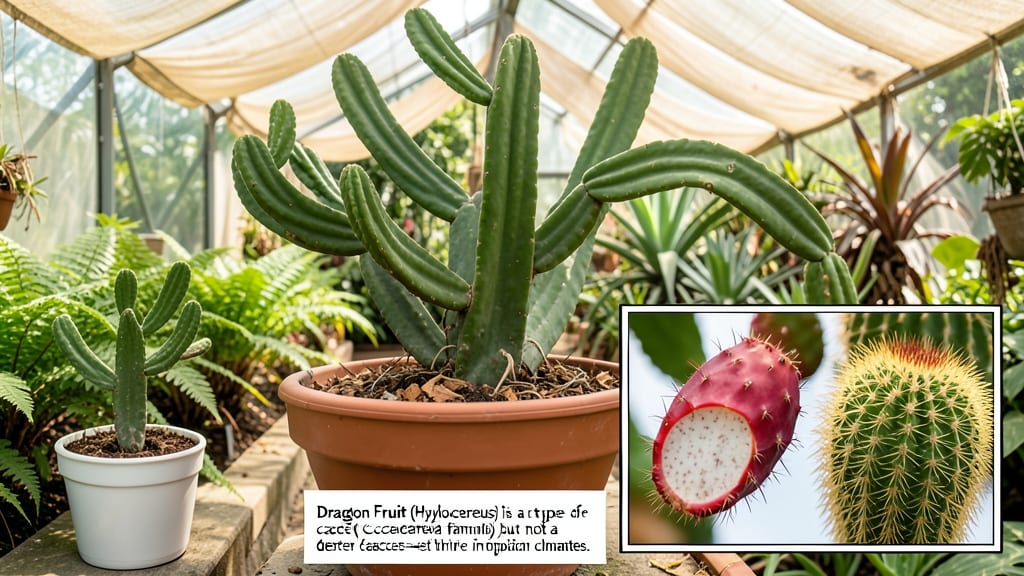
Dragon fruit isn't a cactus but belongs to the Cactaceae family as a close relative of pitaya (Hylocereus) species, which produce its signature fruit. Its vine-like stems and night-blooming flowers share cactus traits but differ in growth habits and fruit structure.
Dragon fruit's connection to cacti comes from its genus Hylocereus, which thrives as a climbing vine rather than a ground-hugging plant. 🌵 Unlike traditional cacti, dragon fruit produces edible fruit from its night-blooming flowers, and its stems are more flexible and woody.
This unique blend of traits explains why it's classified under Cactaceae despite its non-cactus characteristics.
What makes this even more interesting is how dragon fruit grows—it needs support structures to climb, similar to passionfruit vines. While it shares the same family as true cacti, its cultural needs are quite different.
For example, dragon fruit requires more consistent moisture than desert cacti, and its fruit develops from flowers that bloom only at night—a rare adaptation in the plant kingdom.
💡 In This Article
- Dragon Fruit’s Botanical Family: Cactus or Not?
- Growing Dragon Fruit: Cactus-Like Care Tips for Gardeners
Dragon fruit’s botanical family: cactus or not?
The confusion around dragon fruit's classification stems from its placement in the Cactaceae family, which also includes traditional desert cacti like saguaro or prickly pear.
Here's what's actually happening: Dragon fruit belongs to the genus Hylocereus, a group of cacti that have evolved to grow as epiphytic vines rather than upright plants. This means they climb trees or support structures, using specialized aerial roots to anchor themselves—similar to how orchids grow on other plants.
The key difference lies in its growth habits and fruit production. Traditional cacti store water in thick, fleshy stems and produce flowers that rarely yield edible fruit. Dragon fruit, however, develops its signature bright pink or yellow fruit from night-blooming flowers that appear only after 3-5 years of growth.
These flowers are large, fragrant, and white with a red or purple center, opening their petals just as dusk falls—a rare adaptation called nyctinasty that helps attract nocturnal pollinators like moths.
What most people don't realize is how dragon fruit's stem structure differs from typical cacti. While cacti stems are rigid and water-storing, dragon fruit stems are more flexible, resembling a woody vine with segmented joints.
This flexibility allows it to climb and spread over large areas, covering up to 20 feet in ideal conditions. The stems also lack the protective spines of desert cacti, making them softer to the touch and more suited for tropical climates.
This unique blend of traits explains why dragon fruit is classified under Cactaceae despite its non-cactus characteristics. The family includes over 2,000 species, many of which have diverged significantly from the traditional desert cactus image.
Dragon fruit's connection to cacti is more about shared evolutionary ancestry than physical resemblance—like how a dolphin is classified as a mammal despite its aquatic lifestyle.
Consider these key distinctions between dragon fruit and typical cacti:
- Growth form: Dragon fruit climbs as a vine; cacti grow upright or spread horizontally
- Fruit production: Dragon fruit yields edible fruit; most cacti produce inedible flowers
- Water storage: Dragon fruit stems store minimal water; cacti have thick, water-storing stems
- Pollination: Dragon fruit flowers open at night; most cacti flowers open during the day
The night-blooming aspect is particularly fascinating. These flowers release a sweet, musky fragrance that peaks around 10 PM, perfectly timed to attract sphinx moths—their primary pollinators.
This nocturnal adaptation helps explain why dragon fruit thrives in tropical regions where these moths are abundant, while traditional cacti rely on daytime pollinators like bees.
What this means for gardeners is that while dragon fruit shares the same family as cacti, its care requirements are quite different. Unlike desert cacti that need minimal water, dragon fruit requires consistent moisture and thrives in humid climates.
The vine-like growth also means it needs support structures, making it more similar to passionfruit or grapevines than to prickly pear cacti.