
Planting
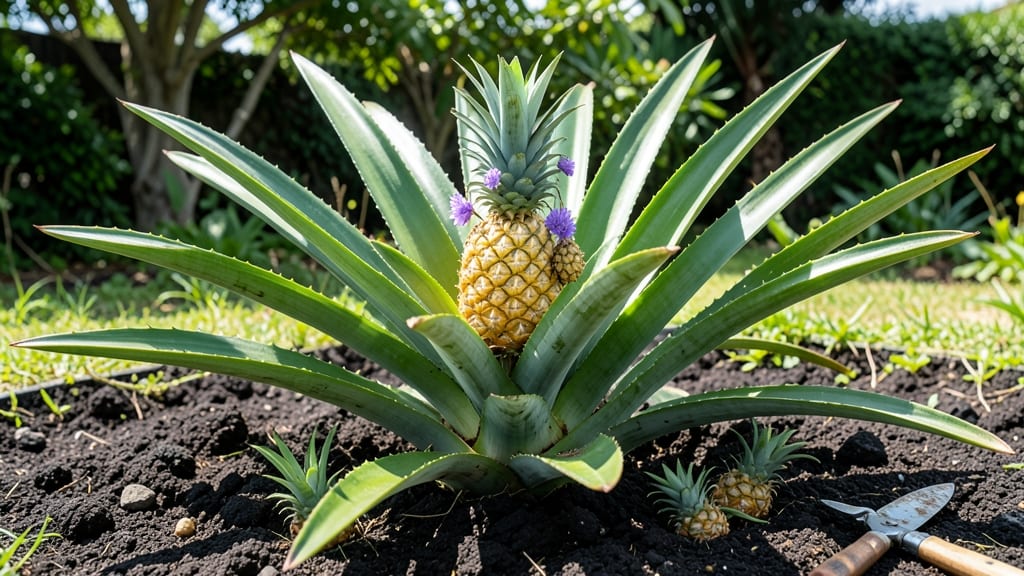
A pineapple plant produces only one fruit per stem in its lifetime, growing from a single flower cluster at the center of the plant. After harvesting, side shoots (pups) can develop, each capable of producing its own pineapple over 18-24 months.
A pineapple plant's single-fruit production comes down to its monocarpic nature—meaning it dedicates all its energy to developing that one central fruit. 🌱 Once fruiting begins, the plant's resources shift entirely to the pineapple, leaving no energy for additional fruits on the same stem.
This is why commercial growers rely on those side shoots (pups) to propagate new plants, ensuring continuous harvests over time.
Here's the kicker: each pup takes 18-24 months to mature into a full-sized pineapple, so patience is key. I've found that maintaining optimal growing conditions—like bright indirect light and well-draining soil—helps speed up the process just slightly.
The trade-off between single-stem yield and pup propagation is what makes pineapple farming both fascinating and labor-intensive.
💡 In This Article
- Why Pineapple Plants Yield Just One Fruit Per Stem
- Maximizing Pineapple Harvest: Pups, Care Tips, and Timeline
Why pineapple plants yield just one fruit per stem
The pineapple's single-fruit production stems from its monocarpic nature—a botanical term describing plants that flower and fruit just once in their lifetime before dying. 🌱 Unlike perennial plants like citrus trees or strawberries, which produce multiple harvests, pineapples allocate nearly all their energy to developing that one central fruit.
This is why you'll never see a pineapple plant with multiple fruits growing simultaneously on the same stem.
The process begins when the plant reaches maturity (typically 18-24 months after planting). A single flower cluster emerges from the plant's crown, developing into the pineapple fruit. During this phase, the plant's leaves continue photosynthesizing, but their primary function shifts from growth to fruit maturation.
The plant's vascular system prioritizes transporting nutrients to the developing fruit, often at the expense of new leaf or stem development.
This energy allocation is extreme—some studies show that up to 90% of the plant's resources go toward fruit development during this period. 🌿 Compare this to bananas, which produce multiple hands (clusters) from the same stem, or figs that bear fruit on multiple branches.
The pineapple's strategy is a trade-off: it invests everything in one high-yield fruit rather than spreading energy across many smaller ones.
What happens after fruiting? The plant's life cycle naturally declines. Once the pineapple is harvested, the original stem often dies back, leaving behind side shoots (pups) at the base. These pups are genetically identical to the parent plant and can be propagated to grow new pineapple plants.
This is why commercial growers rely on this method—each pup becomes a new opportunity for another fruit.
The monocarpic trait isn't unique to pineapples—you'll find it in other tropical plants like bamboo or strawberry plants (though strawberries are technically perennial). The difference is that pineapples don't regrow from the same stem; they depend entirely on pups for continuation.
This biological quirk explains why pineapple farming requires careful planning and patience.
Here's a key insight: the plant's single-fruit strategy makes sense evolutionarily. Pineapples grow in warm climates where resources are often limited.
By focusing all energy on one large, nutritious fruit, the plant increases the chances of successful seed dispersal (via birds and animals attracted to the sweet flesh). 🌟 The trade-off is that each plant has just one shot at reproduction—making those pups critically important for the species' survival.